Family Living on Loughboro: A Colorful Washington, D.C. Home by LL Design House
Updated: Sep 24

Family Living on Loughboro is a Washington, D.C. residential renovation by LL Design House that uses bold wallpaper, layered patterns, saturated color, and existing family pieces to create a home that feels collected, personal, and livable. Rather than starting over, the design builds on furniture, artwork, and pieces the homeowners already loved.
Say hello to proof that “collected, not decorated” isn’t just a nice sentiment, it’s a whole design strategy.
This Washington, D.C. family came to us again (we love a repeat client) with a challenge: keep the pieces they already adore, add the wallpaper and color they’ve always wanted, and don’t you dare make it feel like a showroom.
Because a family actually lives here. They entertain here. Real life happens on these sofas.
What we landed on is proof that bold and livable were never opposites. Here’s the inside look, room by room, plus four rules we use to keep layers of color and pattern feeling intentional rather than chaotic.
How Do You Mix Patterns in Interior Design Without Making a Room Feel Busy?
The key to mixing patterns successfully is connection rather than matching. Choose patterns that share at least one common element—usually color, then vary their scale and balance them with solid fabrics and quieter surfaces. This allows multiple patterns to live together without making the room feel visually chaotic.
In other words: pattern mixing does not mean “everything goes.”
That’s not eclectic. That’s just loud.
The Pattern Mixing Principle: Connect, Don’t Match

Every pattern in a room needs to shake hands with the others through at least one shared element. Usually that connection is color; sometimes it’s scale; often, it’s both.
In the breakfast nook, we layered:
A large-scale floral print on the banquette
A geometric red pattern on the cushions
A striped linen on the throw pillows
Do they match? Not even close.
Do they fight? Not once.
They all speak the same color language: coral, green, and white, which is exactly what turns “a lot” into “just right.”
4 Rules for Mixing Patterns, Wallpaper, and Color
1. Start With a Hero Wallpaper
Every great room needs a leading act. Everyone else is there to support.
Throughout this house, different spaces were given their own star:
The butler’s pantry: bold blue cabinetry paired with geometric wallpaper
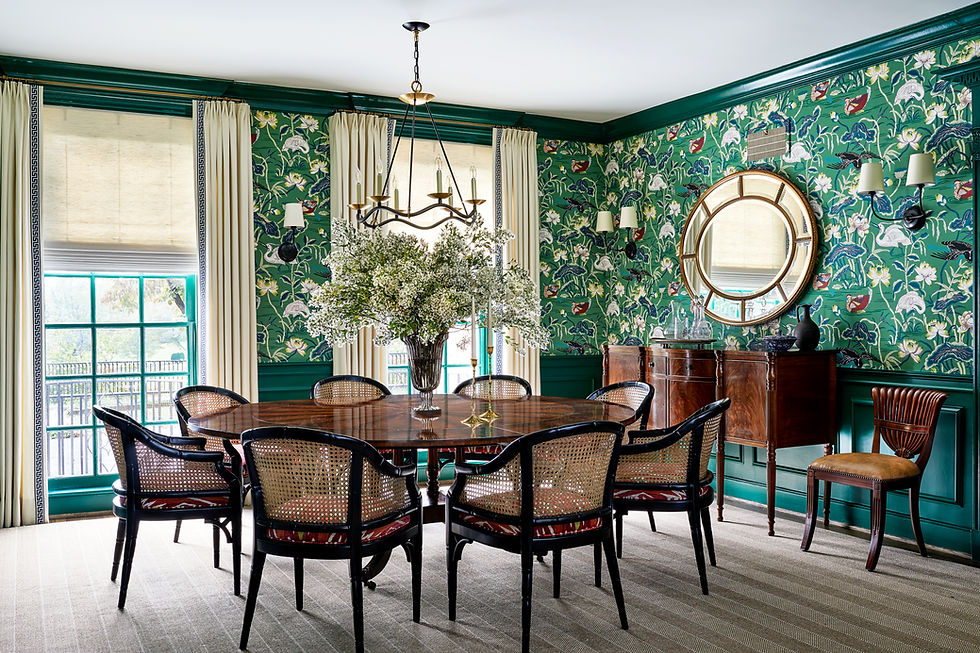
The dining room: floor-to-ceiling magnolia branches
The staircase: grasscloth with quiet confidence
The powder room: leopard, because small spaces deserve big moments
Once your hero wallpaper is cast, everything else should complement it rather than compete with it.
Two bold elements fighting for the spotlight is how you lose the room entirely.
One hero. Everyone else plays a supporting role.
2. Use Color to Connect Different Patterns
Consider color your secret weapon.
Choose a focused palette and commit to it—no cold feet. Your patterns can be wildly different in style: botanical, geometric, striped, abstract, solid. But when they share a color story, they read as one intentional design rather than a mismatched pile-up.
In the living room, that meant:
Navy doing the heavy lifting
White giving everything room to breathe
Blue-and-white patterns carrying the story
A wink of yellow adding an unexpected hit of color
Every fabric and every pillow speaks the same language. That connection is what makes a bold room feel curated instead of chaotic.
3. Vary the Scale of Your Patterns
A room full of tiny patterns can feel fussy. A room full of oversized patterns can feel like it’s shouting at you.
Neither is the goal.
The sweet spot is variation.
Pair a large-scale floral with a medium-scale geometric and a smaller stripe. Changing the scale gives each pattern its own job and lets your eye move around the room without getting exhausted along the way. Pattern mixing works best when the patterns aren’t all competing at the same volume.
4. Balance Patterns With Solid Colors
Here’s what nobody tells you: the quiet moments matter just as much as the bold ones.
In the breakfast nook, the solid green cushions aren’t a break from the design. They’re part of the plan. They give the floral banquette, geometric pillows, and stripes somewhere to land.
When pattern covers every single surface, nothing actually stands out.
There isn’t one magic ratio of pattern to solid that works in every room. Instead, pay attention to visual balance. The more pattern you introduce, the more important solid surfaces and quieter moments become.
Give the room somewhere to exhale.
How Do You Incorporate Furniture You Already Own?

Most homeowners aren’t starting with an empty house and we don’t think they should have to.
There’s inherited furniture. Art collected over the years. Vintage and thrifted finds. The chair you love too much to give up. The sofa that still works perfectly well.
Those pieces aren’t design limitations. They’re part of the story.
This client's dining set was entirely her own, we reupholstered the chairs and designed around what was already there. A favorite pillow suddenly makes sense in a room bold enough to hold its own next to it.
Old and new don't have to compare.
Done well, they make each other better and they create something a room filled entirely with brand-new furniture rarely can: history.
That’s how a home begins to feel collected rather than decorated.
Can Bold Wallpaper and Pattern Work in a Family Home?
Absolutely. A family home doesn’t have to be beige to be functional.
The goal is not to create a room that looks perfect in a photograph but feels precious in real life. Good residential design accounts for how a family actually lives where people gather, entertain, eat, relax, and inevitably drop something on the sofa.
Bold wallpaper, colorful upholstery, and layered patterns can coexist with real life. The key is choosing materials thoughtfully and creating enough visual balance that the home feels energized rather than overwhelming.
Family-friendly and design-forward were never opposites.
The Design Risk That Actually Pays Off
Pattern layering can feel risky because, well, it is.
It’s just a calculated risk.
Connect through color. Lead with a hero wallpaper. Vary your scale. Give bold moments quieter places to land.
And don’t assume everything you already own needs to disappear just because you’re redesigning your home.
Suddenly the “risk” becomes the thing everyone remembers.
Nobody walks away talking about the beige.
They remember the wallpaper. The color they didn’t see coming. The vintage piece sitting confidently beside something brand new. The pattern combination that shouldn’t work but somehow absolutely does.
That’s the risk worth taking.
About the Family Living on Loughboro Project

Location: Washington, D.C.
Project Type: Residential renovation
Interior Designer: LL Design House
Design Style: Colorful, collected, layered, and family-friendly
Key Design Elements: Bold wallpaper, pattern mixing, saturated color, custom upholstery, and existing furnishings
Frequently Asked Questions About Mixing Patterns in Interior Design
How do interior designers mix different patterns in one room?
Start by finding a connection between the patterns, usually a shared color palette. Then vary the scale by combining larger, medium, and smaller patterns and introduce solid colors to create visual breathing room. The goal isn’t for patterns to match; it’s for them to feel intentionally related.
Can you use bold wallpaper in a family home?
Yes. Bold wallpaper can make a family home feel personal and memorable without sacrificing livability. Consider the scale of the pattern, the colors already present in the room, and how surrounding fabrics and furnishings will balance the wallpaper.
Can you mix old furniture with a newly designed room?
Absolutely and existing furniture, art, and collected pieces can make a newly designed room feel more personal. Instead of replacing everything, identify the pieces worth keeping and intentionally connect them to the new design through color, material, scale, or surrounding furnishings.
How many patterns can you use in one room?
There’s no universal number. What matters more is how the patterns relate to one another. Multiple patterns can work beautifully when they share a color story, vary in scale, and are balanced with solids and quieter surfaces.
Ready to Take the Pattern-Mixing Plunge?
If you’ve got pieces you love but you’re nervous about surrounding them with color, wallpaper, and pattern, that’s exactly our kind of project.
Bold doesn’t have to mean chaotic. Collected doesn’t have to mean cluttered. And designing a new version of your home doesn’t mean erasing everything that already makes it yours.
Let’s talk about what bold, layered, and livable could look like in your space.
Comments